Machine Learning From Scratch: A Complete Beginner's Guide
If you are starting from zero, machine learning can feel overwhelming. This guide is designed to give you everything you need to get started, in the right order, with practical milestones and code you can run.
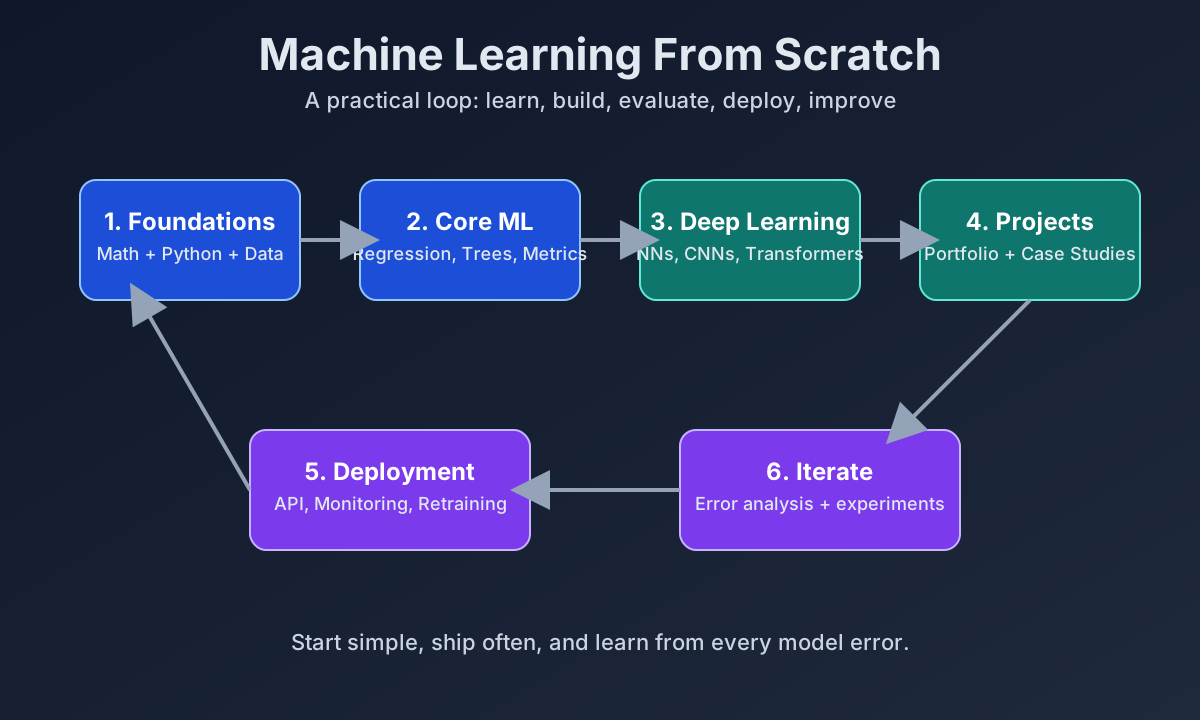
What is Machine Learning?
Machine learning (ML) is the practice of teaching computers to find patterns from data and make predictions or decisions without being explicitly programmed for each case.
Examples:
- Spam filtering in email
- Product recommendations
- Fraud detection
- Image recognition
- Language translation
The 4 Skills You Need First
1) Math basics (only what matters)
- Linear Algebra: vectors, matrices, dot product
- Probability & Statistics: distributions, mean/variance, Bayes intuition
- Calculus: derivatives and gradients (for optimization)
You do not need to master advanced proofs before starting projects.
2) Python programming
Learn:
- Variables, loops, functions, classes
- File I/O and data structures (lists, dicts)
- Virtual environments and package management
3) Data tools
- NumPy for arrays and fast math
- Pandas for tabular data processing
- Matplotlib/Seaborn for plotting
4) ML workflow thinking
Always think in this loop:
- Define problem
- Gather and clean data
- Split train/validation/test
- Train baseline model
- Evaluate with the right metrics
- Improve through iteration
Suggested Learning Path (Step-by-Step)
Phase 1: Build Foundations (2-4 weeks)
- Python fundamentals
- NumPy + Pandas mini exercises
- Basic statistics and probability
- Plot and understand real datasets
Mini project: Predict house prices with a simple linear model.
Phase 2: Learn Classical ML (4-6 weeks)
Core algorithms to learn:
- Linear Regression
- Logistic Regression
- k-Nearest Neighbors
- Decision Trees
- Random Forest
- Gradient Boosting
- k-Means clustering
Core concepts:
- Overfitting vs underfitting
- Bias-variance tradeoff
- Feature scaling and encoding
- Cross-validation
- Hyperparameter tuning
Mini project: Customer churn prediction or spam classifier.
Phase 3: Deep Learning Basics (4-6 weeks)
Learn:
- Neural network fundamentals
- Forward pass / backpropagation intuition
- Activation functions
- Loss functions
- Optimizers (SGD, Adam)
Then move to:
- CNNs for images
- RNN/LSTM basics for sequence data
- Transformers for modern NLP
Frameworks:
- PyTorch (recommended)
- TensorFlow/Keras
Mini project: Image classifier (cats vs dogs) or sentiment analysis.
Phase 4: Real-World ML Engineering (ongoing)
Learn production skills:
- Data versioning
- Experiment tracking
- Model serving (FastAPI/Flask)
- Monitoring and drift detection
- Retraining pipelines
Capstone project: End-to-end ML app with API + dashboard.
Code: Your First ML Model (End-to-End)
from sklearn.datasets import load_iris
from sklearn.model_selection import train_test_split
from sklearn.ensemble import RandomForestClassifier
from sklearn.metrics import accuracy_score, classification_report

# 1) Load data
X, y = load_iris(return_X_y=True)

# 2) Split data
X_train, X_test, y_train, y_test = train_test_split(
    X, y, test_size=0.2, random_state=42
)

# 3) Train model
model = RandomForestClassifier(random_state=42)
model.fit(X_train, y_train)

# 4) Evaluate
preds = model.predict(X_test)
print("Accuracy:", accuracy_score(y_test, preds))
print(classification_report(y_test, preds))
Core Evaluation Metrics You Must Know
- Classification: accuracy, precision, recall, F1-score, ROC-AUC
- Regression: MAE, MSE, RMSE, R²
- Ranking/Recsys: MAP, NDCG, Hit Rate
Choose metrics based on business impact, not convenience.
Common Beginner Mistakes (Avoid These)
- Training before understanding the problem
- Ignoring data leakage
- Evaluating on training data only
- Using accuracy for highly imbalanced data
- Jumping into deep learning too early
- Copy-pasting notebooks without error analysis
Project Ideas for Your Portfolio
Beginner:
- Titanic survival prediction
- SMS spam classification
- Movie recommendation baseline
Intermediate:
- Credit risk scoring
- Retail demand forecasting
- Named entity recognition
Advanced:
- End-to-end RAG assistant
- Real-time anomaly detection pipeline
- Multi-modal classifier (image + text)
90-Day Practical Plan
- Days 1-30: Python + Math + Pandas + 2 small projects
- Days 31-60: Classical ML + model evaluation + 2 intermediate projects
- Days 61-90: Deep learning fundamentals + deploy 1 capstone project
Consistency beats intensity. Even 60-90 focused minutes daily is enough for strong progress.
Best Resources to Learn Faster
- Hands-on courses with projects
- Kaggle competitions and notebooks
- Research paper summaries (after fundamentals)
- Open-source ML repositories
Tip: Learn by building and explaining your model decisions in plain language.
Odes to the Craft
We teach the model, and the model teaches us: not certainty, but pattern; not magic, but method.
In every error lies direction, in every baseline, a beginning, in every iteration, a better question.
Final Advice
Start small, finish projects, and document what you learn. Employers and collaborators care less about how many tutorials you watched, and more about whether you can solve problems with data in the real world.